IGEPIG: New nickel-free final finish for electronics applications
Metal Deposition Solutions

Where the highest signal integrity and increasingly finer line-and-space geometries are required, nickel can become a limiting factor: Our IGEPIG process* therefore completely eliminates the use of nickel and opens up new possibilities for high-performance electronic surfaces.
A comparison of common plating processes highlights the advantages of nickel-free systems
A comparison of common plating systems reveals the advantages of nickel-free final finishes, particularly in high-frequency and fine-line applications.
| Process | Selectivity | HF Application | Shelf life | Bondability | Solderability |
| Nickel-based | |||||
| ENIG |
▮▯▯ |
▮▯▯ | ▮▮▯ | Al | ▮▮▯ |
| ENEPIG | ▮▯▯ | ▮▯▯ | ▮▮▮ | Al/Au | ▮▮▮ |
| Nickel-free | |||||
| DIG | ▮▮▮ | ▮▮▮ | ▮▯▯ | Al/Au | ▮▮▯ |
| EPIG | ▮▮▯ | ▮▮▮ | ▮▮▯ | Al/Au | ▮▮▯ |
| IGEPIG | ▮▮▮ | ▮▮▮ | ▮▮▮ | Al/Au | ▮▮▮ |
The nickel-containing processes ENIG (Electroless Nickel, Immersion Gold) and ENEPIG (Electroless Nickel, Electroless Palladium, Immersion Gold) exhibit, compared to the nickel-free processes DIG (Direct Immersion Gold), EPIG (Electroless Palladium, Immersion Gold) and IGEPIG, significant shortcomings in terms of selectivity (“pattern ability”) and suitability for high-frequency applications.
Unlike the previous ENEPIG reference layer system, the IGEPIG process does not require a nickel layer and, consequently, does not require an activator system. Instead, IGEPIG combines a thin gold seed layer as a catalytic substrate for the subsequent palladium deposition with a final gold top layer. This eliminates the disadvantages associated with a nickel layer, without compromising functionality.
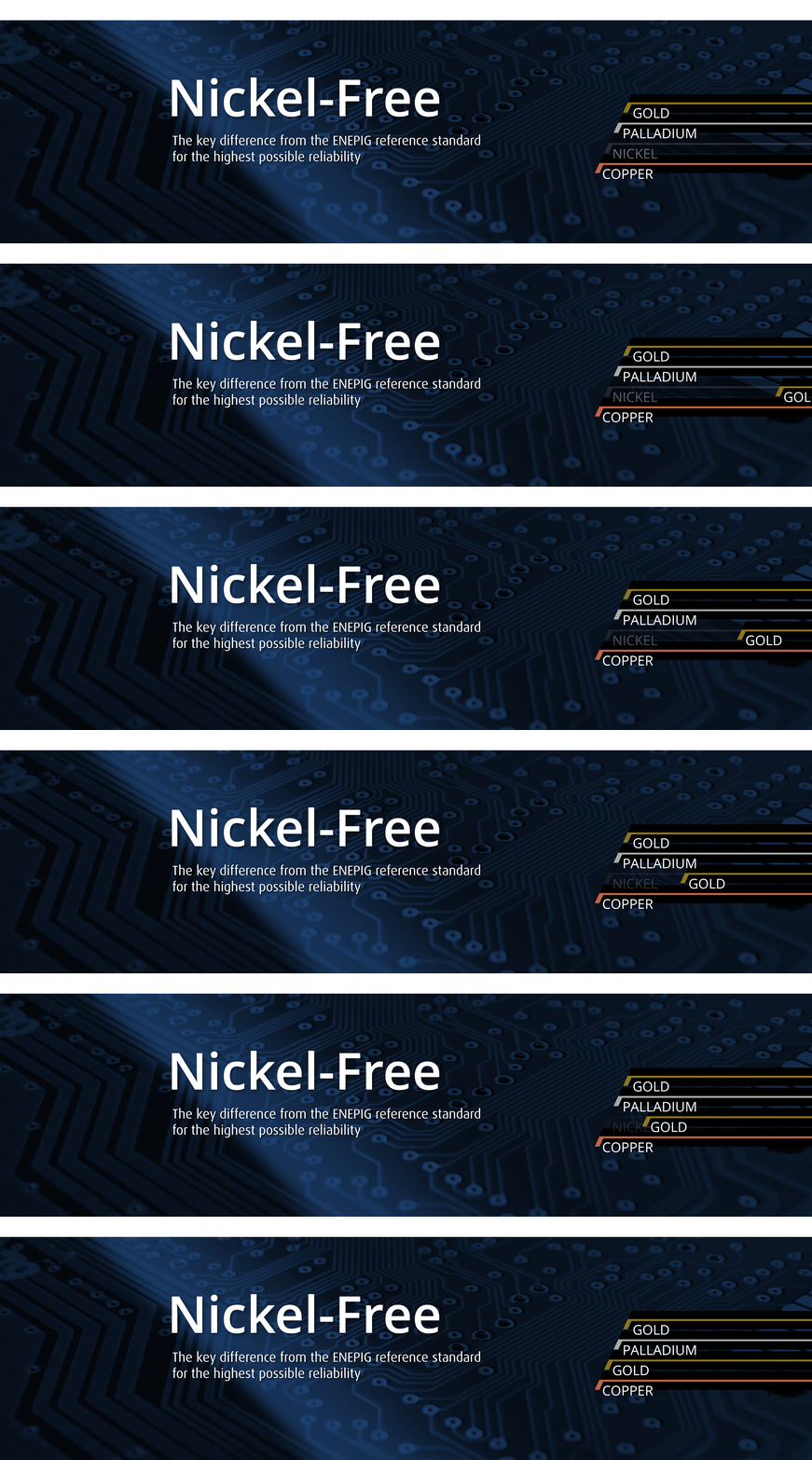
With rising frequencies, increasing miniaturization and the need for flexibility in some cases, the choice of a final finish is becoming increasingly important. The entire layer structure of the IGEPIG process is designed to meet the electronics industry’s high reliability requirements.

High-Frequency Application
Prevention of signal loss, attenuation, and interference

Ultra-Fine Line structure
Enabling a smaller spacing between line-and-space geometries

Substrate flexibility
A reliable coating for flexible copper surfaces
Why is nickel becoming a challenge for certain applications?
In high-frequency applications, nickel-containing layers can contribute to signal attenuation due to nickel’s ferromagnetic properties. This effect becomes more pronounced at higher frequencies, as the skin effect causes current to concentrate increasingly at the conductor surface. As a result, nickel can become a limiting factor in applications where high-frequency signal transmission with minimal loss is critical.
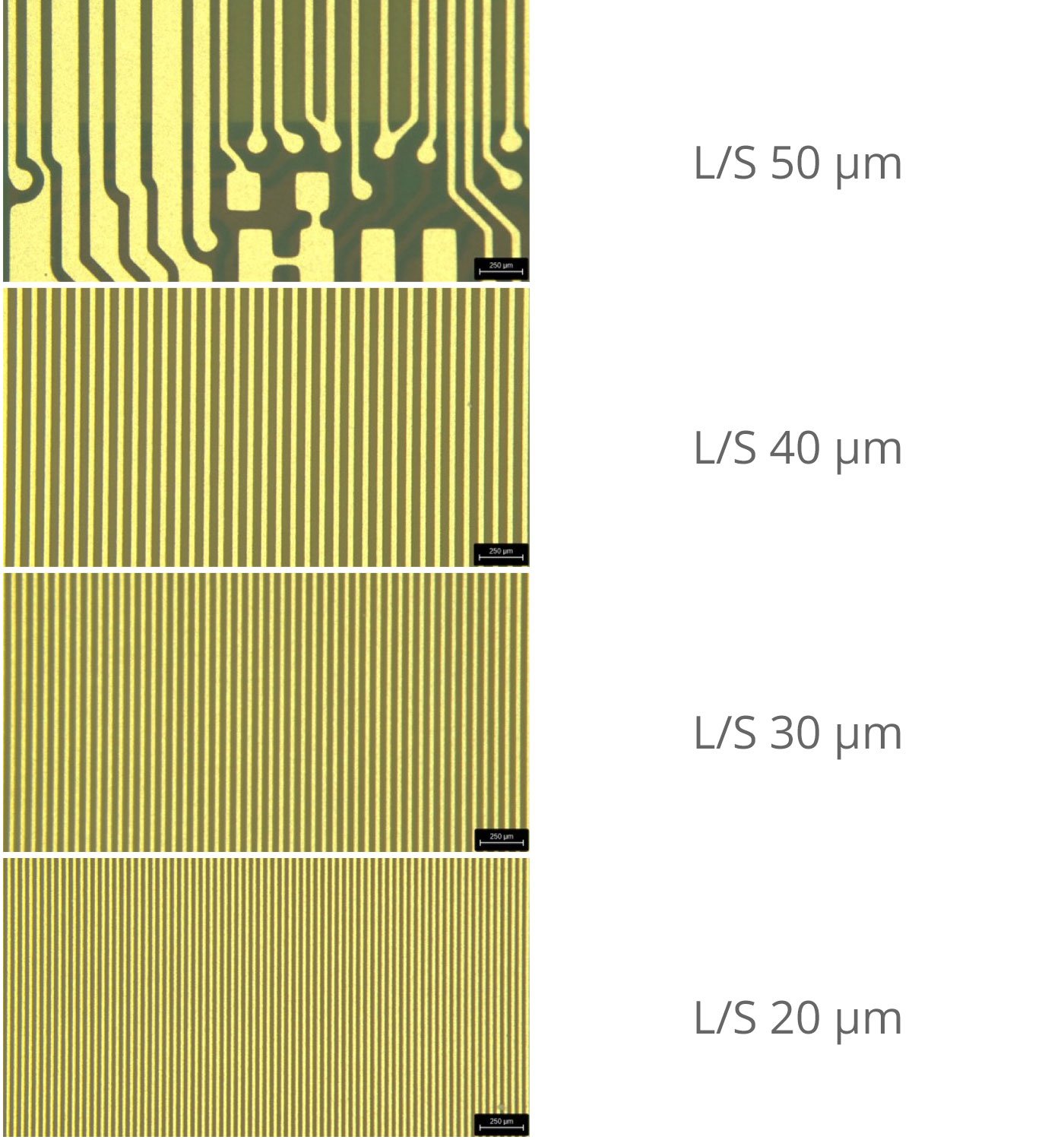
With the continuing miniaturization, conventional nickel-based plating systems are increasingly reaching their limits. IPC specifications 4552 for ENIG and 4556 for ENEPIG stipulate nickel coating thicknesses of 3 to 6 µm to ensure an effective diffusion barrier. These comparatively high coating thicknesses limit the available spacing between very fine line-and-space geometries. Added to this is the activator system required for nickel deposition, whose residues can promote footing or stray plating for fine structures smaller than 50 µm, thereby causing short circuits. IGEPIG, on the other hand, does not require a nickel layer or the associated activator system. This reduces these risks of footing and stray plating and allows the successful realization of small line-spaces of less than 20 µm.
Due to the comparatively lower ductility of nickel, the mechanical flexibility of the coated copper may be limited. A nickel-free layer structure is therefore particularly well-suited for applications in which flexible copper surfaces must be reliably plated.
This creates a clear need for substrate manufacturers and assemblers: a final finish that does not contain nickel while still providing the necessary bondability, solderability and electrical contact performance. This is precisely where the IGEPIG process comes into play.
Potential Applications
- High-frequency applications
(such as antenna modules) - Ultra-fine line
(with low line-to-space) - AI/high-speed servers
- Advanced packaging
- Flexible PCBs
- Medical and laboratory technology
Possible line and spaces
IGEPIG is nickel-free and yet offers the highest level of functional reliability
The IGEPIG process completely eliminates the use of nickel without sacrificing the properties essential for a reliable final finish. This is because, in established ENEPIG plating systems, nickel not only serves as the basis for palladium deposition but also contributes to solderability and acts as a diffusion barrier against the underlying copper. With IGEPIG, these functions must therefore be reliably ensured by the nickel-free plating structure.
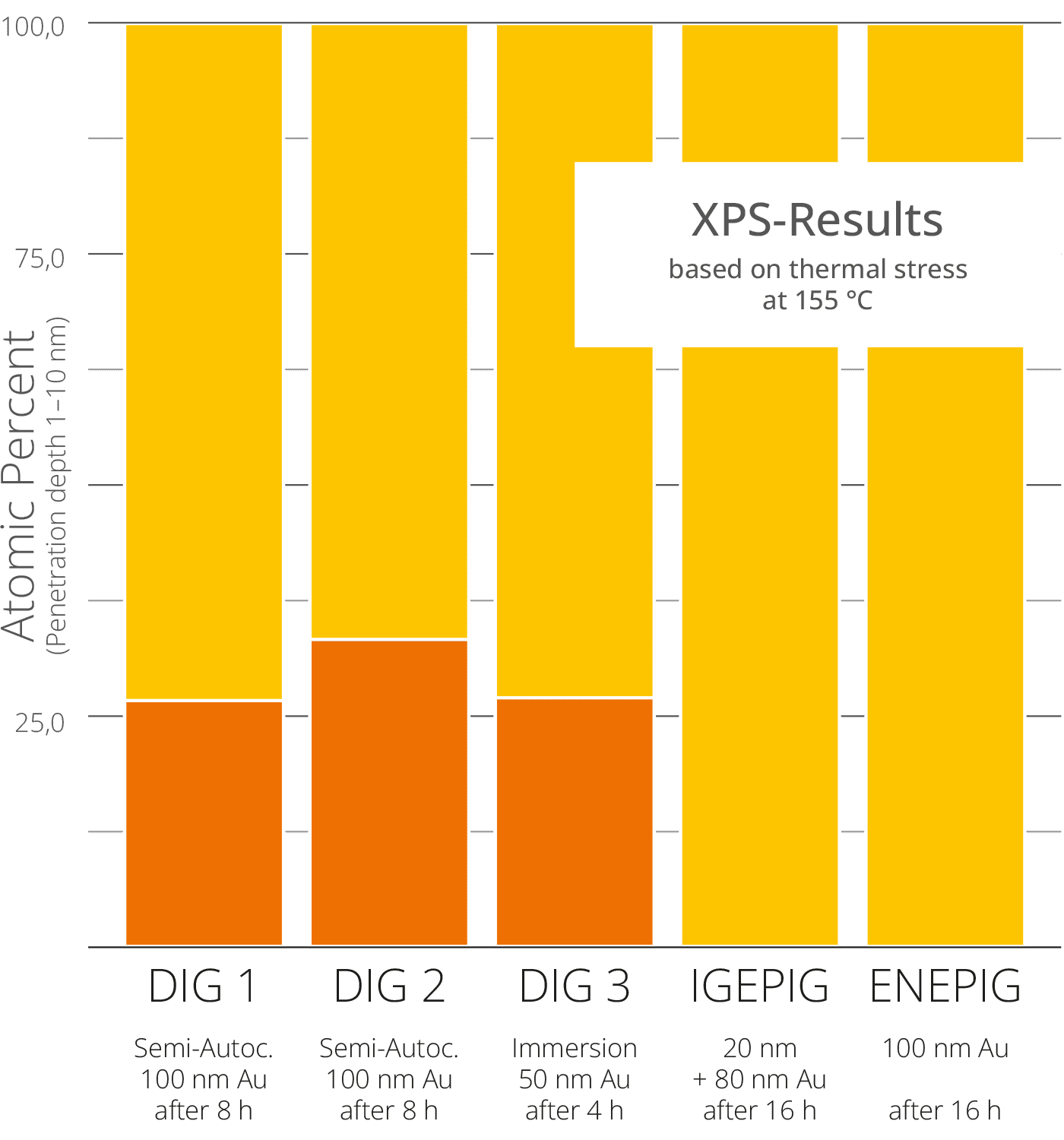
For this reason, the palladium layer deposited homogeneously and in a controlled manner on the catalytically active gold seed layer plays a central role in the IGEPIG process: As in the ENEPIG process, it acts as a diffusion barrier between copper and gold and suppresses their diffusion (see the accompanying XPS analysis). This is particularly relevant when final finishes are subjected to thermal stress. This ensures longer-term bond and solder stability compared to the DIG process.
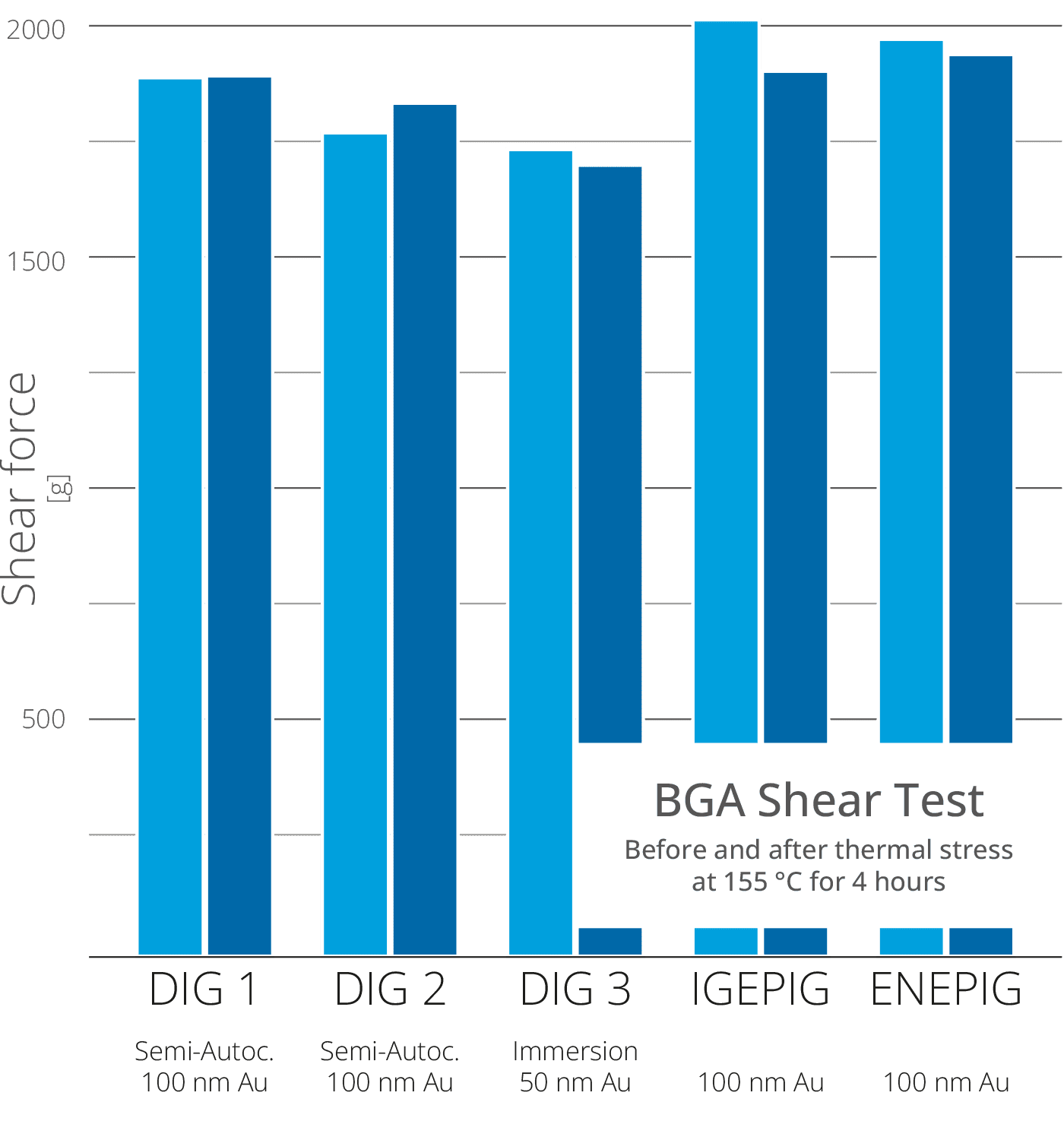
The reliability of the solder joints and, consequently, the long-term reliability of electronic assemblies was confirmed in a BGA shear test. In this test, the IGEPIG plating system proved to be equivalent to the ENEPIG plating system, as both exhibited the highest shear forces among the variants tested, particularly after thermal stress at 4 h/155 °C (see the accompanying BGA shear test).
The IGEPIG process thus meets two key requirements. It eliminates the use of nickel while ensuring the best possible functional reliability of the layer system.

The standard structure of the IGEPIG layer system consists of a 20-nm gold seed layer, a 100-nm palladium diffusion barrier and an 80-nm gold top layer. Compared to a DIG structure, which requires a gold layer thickness of at least 150 nm to achieve comparable long-term reliability, IGEPIG enables a material-efficient use of gold.
However, not every application requires the additional palladium diffusion barrier of the IGEPIG layer system. In such cases, a simpler DIG structure may be the appropriate solution. This is precisely where the 2-in-1 process concept offers additional flexibility: In the IGEPIG process, the same gold process handles both the deposition of the gold seed layer and the final gold layer, and can also be used for DIG. This allows you to choose between IGEPIG and DIG depending on the application, without having to maintain a separate DIG gold process.
A high-end finish that offers you the benefits of being nickel-free and highly reliable in terms of functionality
The IGEPIG process offers a solution that eliminates the need for nickel in the layer structure, not only in printed circuit board and semiconductor applications.
Would you like to evaluate its suitability for a specific high-frequency, fine-line, power electronics or medical technology application, or compare your current final finish option with IGEPIG? Our experts will be happy to assist you.
Upon request, we can support you as early as the initial project phase with
- test coatings for initial technical evaluations
- application-specific cost-benefit analyses
- consulting on the appropriate process landscape and necessary equipment
- support with the implementation of the process.
Talk to us about your application. Together, we’ll explore how easily IGEPIG can be integrated into your manufacturing process and what technical and economic potential a nickel-free finish offers for your project.

Contact person
Markus Legeler
Manager Sales International
markus.legeler@eu.umicore.com
Start Teams Chat
+49 7171 607 204 (Office)
* We are the exclusive distributor in Europe for the IGEPIG process developed by Uyemura

Website content related to this page


