Ultra-thin, uniform platinum coating for PTLs in PEM electrolysers
Metal Deposition Solutions

In the rapidly evolving market for PEM electrolyzers, porous transport layers (PTLs) made of titanium are increasingly recognized as a key component. Titanium offers several advantages over other metals, such as stainless steel.
In particular, it is its durability in oxygen-rich environments, such as those found in PEM electrolyzers. During anodization, titanium naturally forms resistant oxides. However, without a protective layer, the interfacial resistance increases, leading to efficiency losses and accelerated degradation.
The platinum coating on titanium PTLs has a wide range of positive effects
Platinum coatings on titanium PTLs address this issue, thereby improving the performance and lifetime of the electrolyzer. Using an advanced electrochemical deposition process, highly uniform and ultra-thin coatings can be produced, which have a particularly positive impact on efficiency, durability and total cost of ownership.

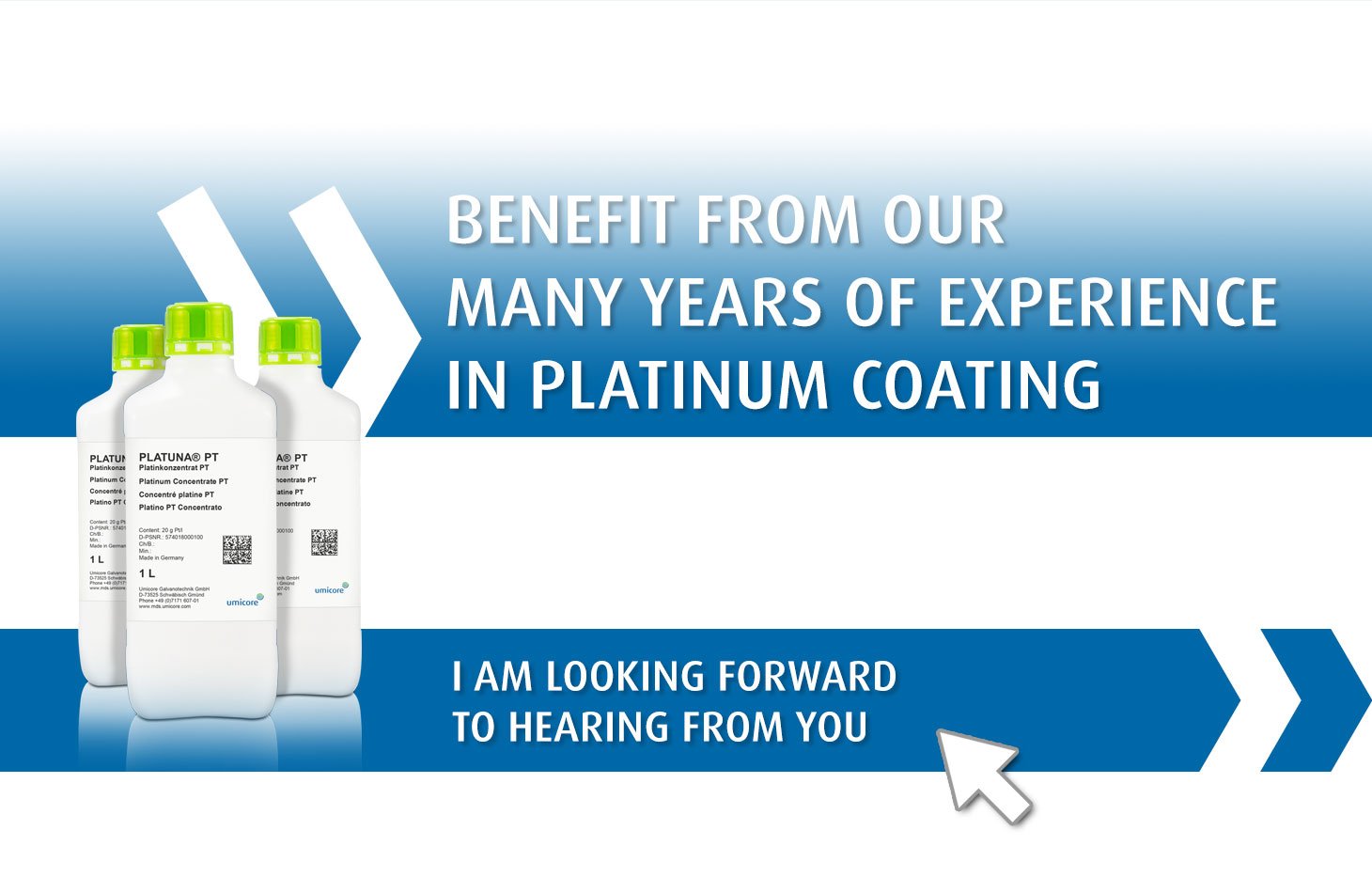
Our PLATUNA® sets new standards for functional nanometer-scale platinum coatings for PEM electrolysers. The coating thickness, opacity and homogeneity are exceptional and cannot be achieved with other coating methods.
PLATUNA® is suitable for all PTL types and is already being successfully used as a 30 or 50 nm platinum coating. It is deposited directly onto the porous titanium structures.
Compared to competing coating technologies, our electrochemical process is characterized by more precise application and a surface coverage of >85%.
Visual proof of the performance of PLATUNA®
100 nm platinum layer

100x magnification

5,000x magnification

20,000x magnification
50 nm platinum layer

100x magnification

5,000x magnification

20,000x magnification
30 nm platinum layer

100x magnification

5,000x magnification

20,000x magnification

Ultra-thin functional coatings are often associated exclusively with PVD (Physical Vapor Deposition) technology. However, our PLATUNA® demonstrates that, with the right electrolyte and the necessary expertise, electrochemical deposition of porous titanium PTLs is not only possible but is often superior in terms of quality, scalability and cost-effectiveness.
Electrochemical deposition is qualitatively superior to the dry process
Thanks to the significantly better throwing power of our electrolyte in the wet process, quality issues can be avoided, such as:
- Local variations in thickness
- Shadowing effects
- Large uncoated areas
This effectively eliminates the risk of corrosion hotspots and early PTL failure. At the same time, the homogeneous deposition – which is not limited to the line of sight – results in improved electrical performance.
| Criteria | Electroplating | PVD |
| Achievable thickness | 20–100 nm (controlled) | 5 – 200 nm |
| Direct deposition on titanium | Yes, excellent adhesion | Possible, but more complex |
| Coverage on porous PTLs | > 85 %, largely closed | Limited by line of sight |
| Uniformity | High, conformal | Moderate, often causes shadows |
Comparison of Quality
In the electroplating process, both the controlled deposition of the coating and its quality at low thicknesses meet industry requirements. These results cannot be achieved with other coating methods.
| Criteria | Electroplating | PVD |
| Processing speed | Fast | Slow to moderate |
| Capital expenditures (CAPEX) | Low | Very high |
| PTL size limitations | Minimal | Strict size restrictions |
| Cost per part | Low | High |
Comparison of Scalability
The limited chamber volume makes it difficult to scale PVD coating processes flexibly. Electrolytic processes can be adapted to industrial requirements (volume and high reproducibility) with practically no restrictions.
Electroplating – by far the most cost-effective process in many respects
Electrolytic platinum deposition on PTLs is considered the most cost-effective process during ongoing operation. This is primarily due to the comparatively low energy requirements and the moderate investment and maintenance costs for the process infrastructure. Furthermore, because of the very high processing speed, the space requirements are lower, meaning that significantly less production floor area is required, which can also offer financial advantages.
In addition, depending on the use of platinum, precious metal costs can be reduced by well over half. While many providers remain limited to a layer thickness of 100–200 nm due to the limitations of the process described above, PLATUNA® makes it possible to achieve the benefits of a platinum coating with a layer thickness well below 100 nm.

The price of platinum more than doubled last year. As a result, the cost of this precious metal has become even more significant.

Thanks to our decades of experience in the development of electrolytes as well as in the industrial application of electrochemical coating processes, Umicore MDS is a reliable partner for the platinum coating of components for PEM electrolysers.
With us, you have an experienced partner for innovative platinum coatings in PEM electrolysers at your side
We would be pleased to evaluate the possibilities of our electrolytic process together with you. Upon request, we can also provide a test coating for your components. Please feel free to contact us.

Contact person
Markus Legeler
Manager Sales International
markus.legeler@eu.umicore.com
Start Teams Chat
+49 7171 607 204 (Office)

Website content matching this page


